
One small board.
Every protocol you need.
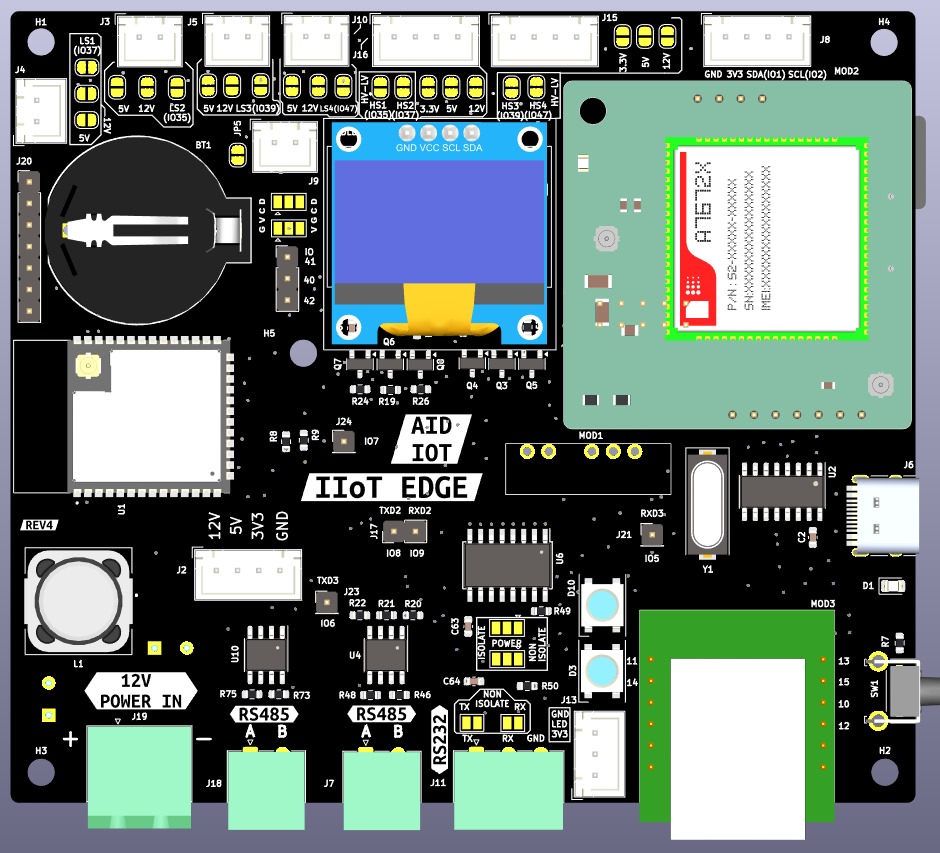
IoT Edge Lite is a compact, dual-core edge node built for sensor interfacing and end-of-line deployments. Wired and wireless comms ship onboard — RS485 ×2, RS232, Ethernet, USB, 2G/4G, Wi-Fi, BLE — with OLED, RTC, microSD, and 27 GPIO ready to go.
240 MHz
Dual-core Xtensa LX7
16 MB / 8 MB
Flash / PSRAM
12–40 V DC
Wide industrial input
0 – 60 °C
Operating range
25.4 × 60 mm
Compact footprint
5 V @ 2 A
Onboard rail
Communication
Every protocol you'd plug in — already onboard.
Out of the box, IoT Edge Lite speaks the wired buses used on the factory floor and the wireless stacks used in the field. No daughterboards required.
WIRED INTERFACES
RS485 × 2
Industrial multi-drop
Isolated RS232
Galvanically isolated
Ethernet
10/100 onboard
USB
USB 2.0 OTG · Type-A / Type-C
UART × 3
Hardware serial
I²C × 2
Sensor / display bus
SPI × 2
High-speed peripheral
WIRELESS STACKS
Wi-Fi
802.11 b/g/n · 2.4 GHz · 20/40 MHz
BLE 5
Mesh · 125 Kbps – 2 Mbps
4G LTE
Cellular backhaul
2G GSM
Fallback connectivity
Onboard Peripherals
What you'd usually solder on, already there.
Display, indicators, time-keeping, storage, GPIO, level translation, and relay drive — every block a typical edge deployment adds is on the board from the factory.
0.96" OLED Display
Onboard status & diagnostic readout — no extra harness.
Addressable LEDs
User-controllable RGB indicators for state and alert signalling.
Real-Time Clock
Onboard RTC keeps time across power cycles for stamping events.
microSD Card
Local logging, firmware staging, and offline data buffering.
USB Type-A + Type-C
Host and device ports for external storage, programming, and bridges.
GPIO Headers
27 digital I/O brought out for sensors, switches, and actuators.
Logic-Level Converters
Speak 1.8 V, 3.3 V, or 5 V peripherals without adding glue logic.
High-Current Relay Drivers
Drive contactors and motorised loads up to 2.5 A directly.
Board Overview
Where everything lives — at a glance.
Every connector, module, and indicator labelled. From the 12 V terminal block to the 4G modem and the OLED status display, the layout is documented and consistent across runs.
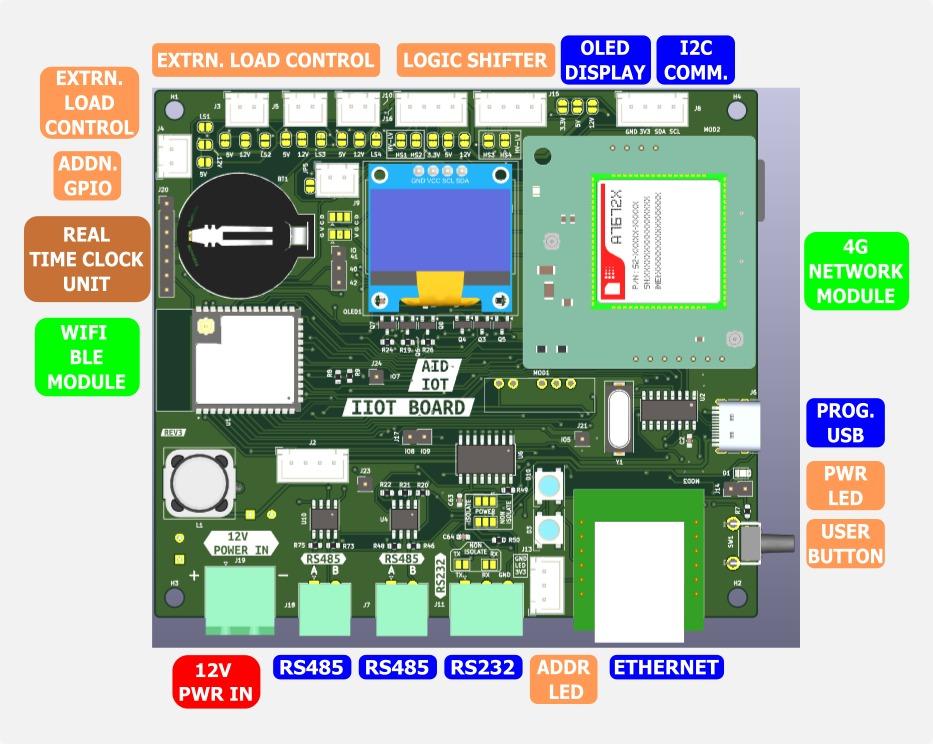
Annotated board layout — connectors, modules, and indicators
Hardware Specs
The numbers behind the board.
A snapshot of the compute, electrical envelope, and radio stacks shipped on every IoT Edge Lite unit.
PROCESSOR
Compute Core
- Processor
- Xtensa® dual-core 32-bit LX7
- Main frequency
- 240 MHz
- SRAM
- 512 KB
- ROM
- 384 KB
- Flash
- 16 MB
- PSRAM
- 8 MB
- RTC SRAM
- 16 KB
- USB
- USB 2.0 OTG full-speed
POWER & ENVELOPE
Electrical & Mechanical
- VIN input voltage
- 12 V – 40 V DC
- Type-C input voltage
- 5 V
- Operating voltage
- 3.3 V
- 5 V rail max output
- 2 A
- Motor drive capacity
- 2.5 A
- Operating temperature
- 0 °C to 60 °C
- Dimensions
- 25.4 × 60 mm (2.95 × 3.54 in)
WI-FI
802.11 Connectivity
- Protocol
- IEEE 802.11 b / g / n
- Bandwidth
- 20 MHz and 40 MHz @ 2.4 GHz
- Modes
- Station · SoftAP · SoftAP + Station
- Frequency
- 2.4 GHz
- Frame aggregation
- TX / RX A-MPDU, A-MSDU
BLUETOOTH
BLE 5 + Mesh
- Protocol
- Bluetooth 5 · Bluetooth mesh
- Rates
- 125 Kbps · 500 Kbps · 1 Mbps · 2 Mbps
I/O & Ports
Plenty of pins for real-world signals.
A generous spread of digital, analogue, serial, and PWM lines — enough for the typical sensor cluster, plus headroom for actuators and indicators.
27
Digital I/O
8 channels
LED PWM controller
× 2
SPI
× 3
UART
× 2
I²C
× 2
I²S
2 × 12-bit · 20 ch
SAR ADC
× 8
Logic-translate I/O
Programming & Deployment
Bring your firmware, ship it your way.
Flash over a USB cable on the bench, or push an OTA build to fleets in the field — both paths are supported on every unit.
Wired programming
Connect via USB Type-C for first-flash, bring-up, and debug. Standard toolchain support, no proprietary programmer.
Over-the-Air (OTA) updates
Push signed firmware to deployed units over Wi-Fi or cellular — roll out fixes and features without truck rolls.
Have a problem?
We design, deploy, and scale the
solution.
