
Track every assets
inside the perimeter — without internet.
TrackNet is a self-contained locality movement tracking system built on LoRa mesh radio. Card-size person tags, solar fixed nodes, and an on-prem dashboard — no SIM, no internet, no cloud.
System at a glance
Three hardware layers, one private LoRa mesh.
Person tags broadcast GPS positions over LoRa. Fixed nodes and relay devices form the mesh that carries packets across the locality. A gateway relay device forwards data to the local server that drives the live dashboard.
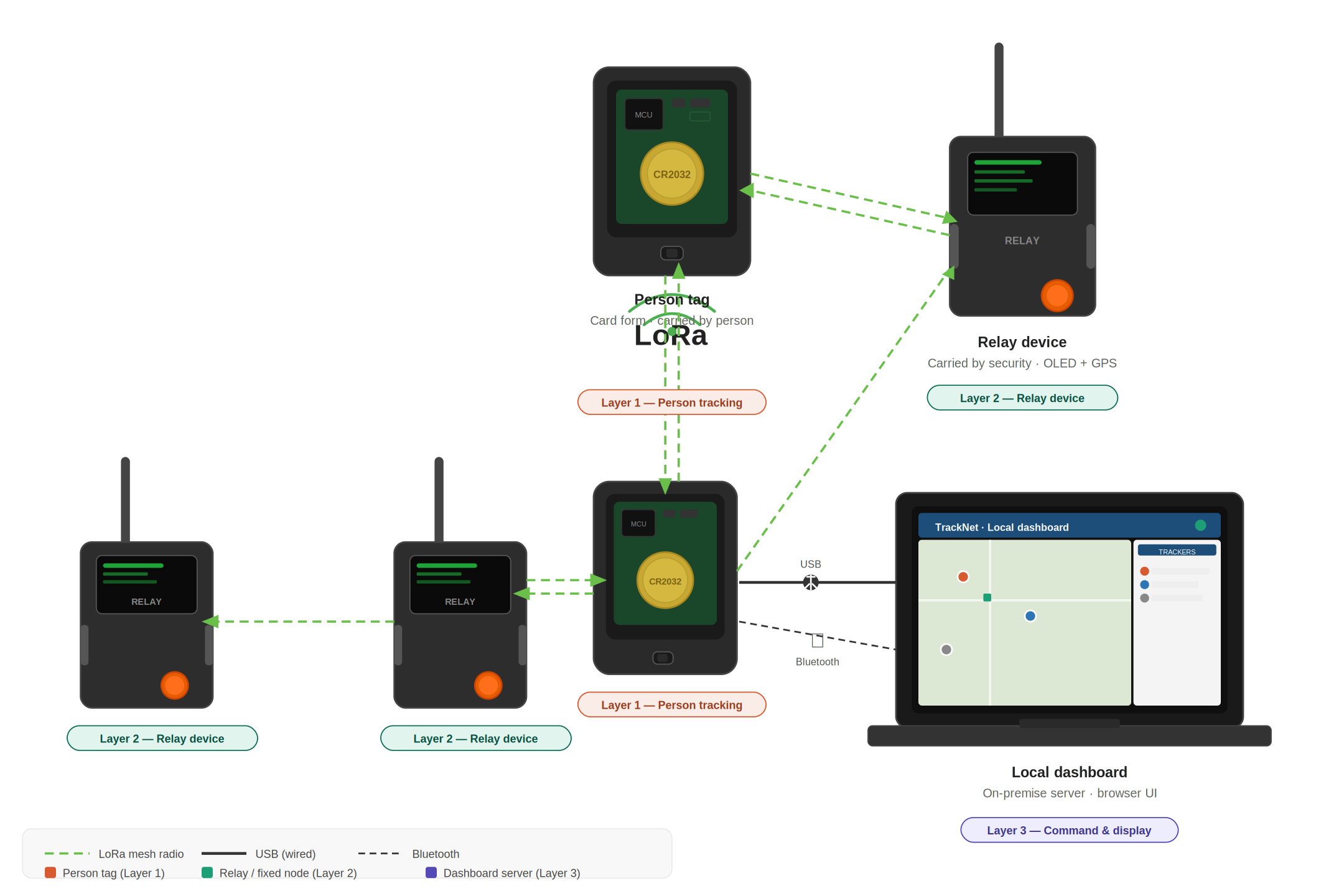
Figure — TrackNet hardware components and communication links
LAYER 1
Tracking
Person tag — card form, carried by the tracked individual. Broadcasts GPS position over LoRa at regular intervals.
LAYER 2
Infrastructure
Fixed nodes (solar) and rugged handheld relay devices form a self-healing LoRa mesh covering the entire locality.
LAYER 3
Command
Local server receives packets from the gateway relay, processes events, and serves the live dashboard over the LAN.
DESIGN PRINCIPLES
Offline-first
Fully self-contained, no internet required.
GPS-derived
Position comes from the tag, not the network.
Mesh redundancy
Multi-hop routing survives node failures.
Configurable firmware
TX intervals, payload, power modes.
Scalable
Add fixed nodes incrementally as you grow.
Use Cases
Five operational scenarios, one tracking platform.
TrackNet is designed for any controlled locality where personnel movement must be visible — without depending on a mobile network or cloud service.
Personnel Tracking in Restricted Areas
- Track authorised personnel inside compounds, campuses, or industrial sites
- Block unauthorised entry into restricted or hazardous zones
- Real-time visibility to a central security desk — no mobile network needed
Security Patrol Monitoring
- Monitor patrol routes of security personnel carrying relay devices
- Verify patrol coverage of all designated checkpoints
- Detect deviations from assigned routes and trigger alerts
Event & Crowd Management
- Track registered participants or VIPs at events and exhibitions
- Identify crowd concentrations and movement patterns
- Coordinate evacuations using the last-known position of every tagged person
Construction & Industrial Site Safety
- Monitor worker locations across large sites and warehouses
- Account for all personnel during emergencies or roll calls
- Record zone entry/exit timestamps for compliance and audit
Educational or Institutional Campus
- Track movement of students, staff, or visitors across a campus
- Automate attendance via proximity to fixed nodes
- Alert admins when a person enters an off-limits area
How it works
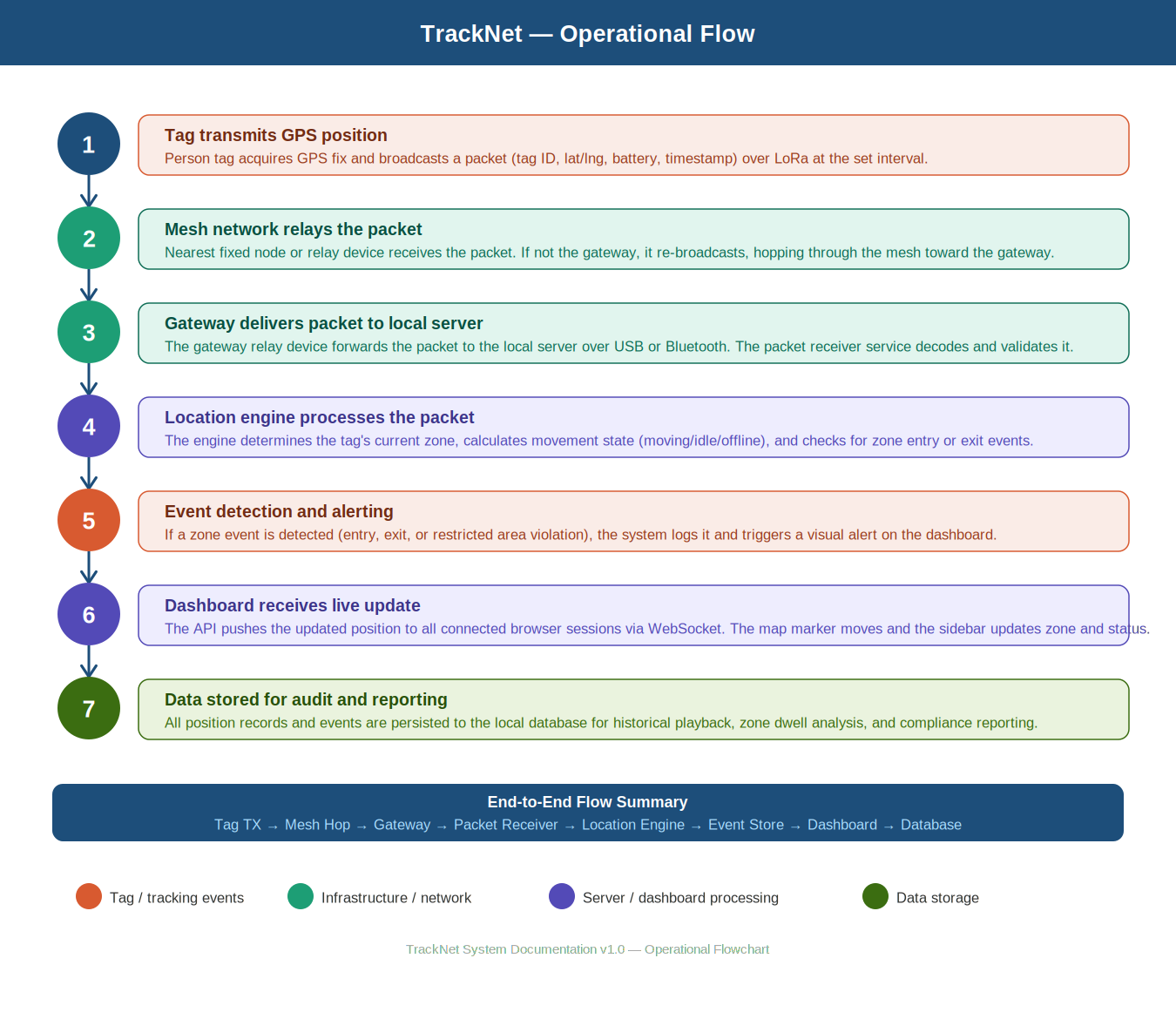
From tag transmission to dashboard update — seven steps, under 60 seconds.
End-to-end latency from a tag broadcast to a marker moving on the dashboard stays under one minute on a healthy mesh.
- 1
Tag transmits GPS position
The tag acquires a GPS fix and broadcasts a compact LoRa packet at the configured interval (default 30 s).
- 2
Mesh network relays the packet
The nearest fixed node or relay device receives the packet and hops it through the mesh toward the gateway.
- 3
Gateway delivers packet to local server
The gateway relay forwards the packet to the local server over USB serial or Bluetooth.
- 4
Location engine processes the packet
Determines the tag’s current zone, calculates movement state, and detects zone entry/exit events.
- 5
Event detection and alerting
Zone events or restricted-area violations log to the event store and can trigger dashboard alerts.
- 6
Dashboard receives live update
The dashboard API pushes the new position to connected browsers over WebSocket — markers move in real time.
- 7
Data stored for audit and reporting
Positions and events persist to the local database for historical playback and compliance review.
Hardware
Field-ready devices, built for continuous service.
Card-size tags, solar-powered outdoor mesh nodes, and rugged handheld relays — engineered to drop into any locality.
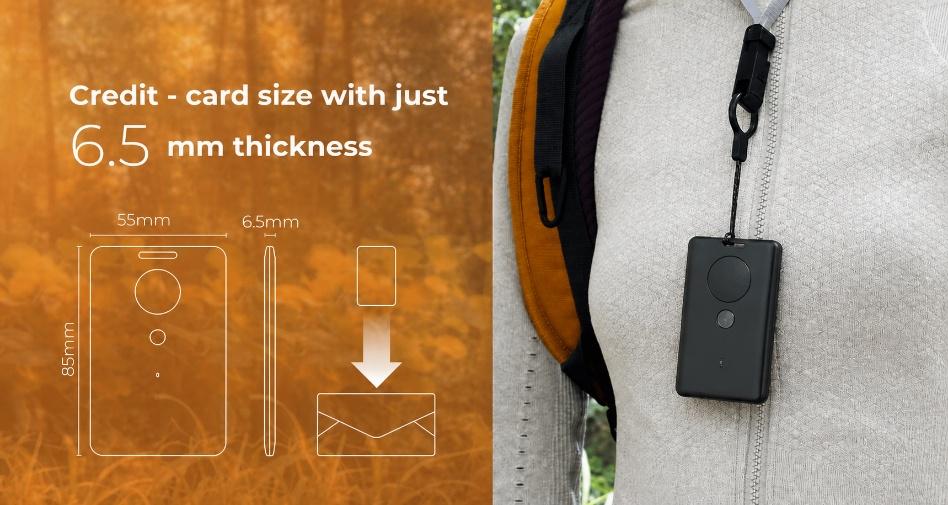
PERSON TAG · CARD FORM
Wear it on a lanyard. Forget it’s there.
Credit-card sized, 6.5 mm thick. Onboard GNSS, magnetic-USB charging, and up to 24 h of continuous LoRa transmission per charge.
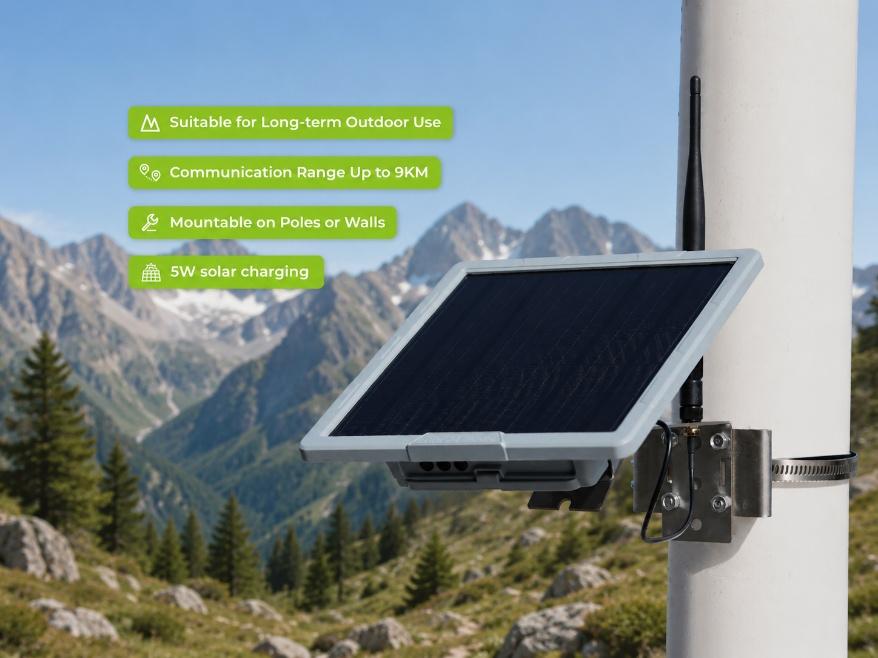
FIXED NODE · SOLAR
Mount it on a pole. Never plug it in.
Weatherproof, solar-charged LoRa repeater. Self-heals into the mesh — add more units to grow coverage without reconfiguring.
RELAY DEVICE · HANDHELD
Carried by security, doubles as gateway.
Rugged 3D-printed enclosure, OLED screen showing nearby tags and mesh status, BLE 5.0 for configuration and as the server gateway. 8+ hours of field use per charge.
LOCAL SERVER · ON-PREM
A Linux box on your LAN. That’s it.
Any Linux-capable SBC or PC. 2 GB RAM minimum, 16–32 GB storage, Ubuntu 22.04 LTS. USB serial or Bluetooth to the gateway relay — dashboard served on the local network.
Live Dashboard
The whole locality, on one screen.
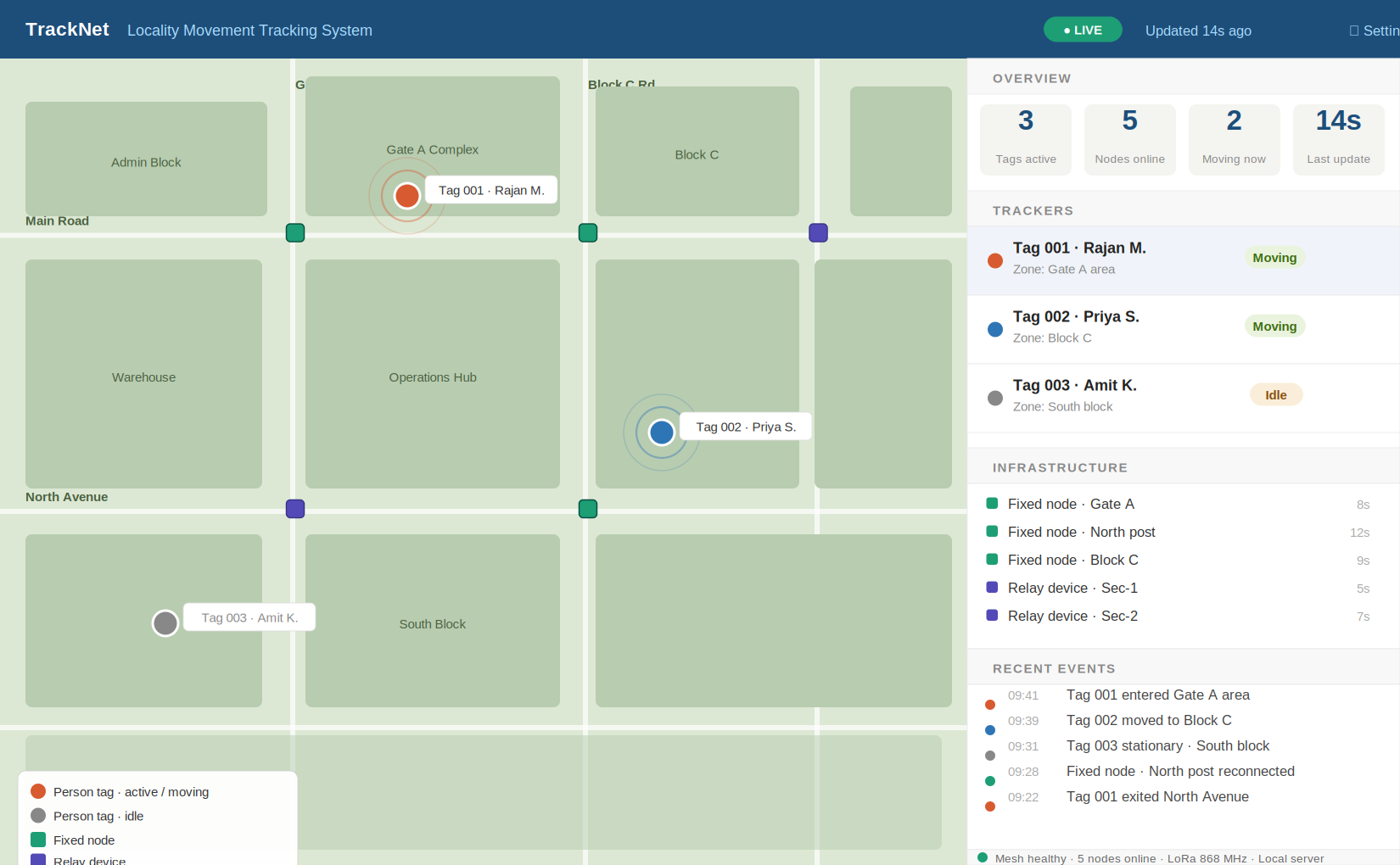
A browser-based single-page dashboard accessible on the local network — no software install for operators. Designed for non-technical security and operations staff.
Real-Time Position Tracking
Live GPS position for every active tag — pulsing markers for moving, dimmed for idle, flagged for offline.
Zone Management & Geofencing
Draw named zones on the map. The system auto-detects entry/exit; restricted-zone breaches raise on-screen alerts.
Historical Playback
Replay any tag’s movement over a chosen period. Path overlays the map with per-position timestamps and zone dwell times.
Infrastructure Health
Last-heard timestamps and signal strength per node. Offline nodes flagged automatically against a configurable threshold.
Event Logging & Audit Trail
Every zone entry, exit, and status change logged with precise timestamps. Filter, search, and export to CSV for compliance.
Multi-User Access
Multiple operators view the dashboard simultaneously. Admin and operator roles separate configuration from read-only access.
Operational Requirements
Built to operate under real-world conditions.
The conditions TrackNet must reliably meet in the field — from offline networks to overnight power and multi-user access.
Network & Connectivity
Operates entirely offline — no SIM, no cellular, no internet. All communication uses LoRa radio (862–930 MHz) with a self-healing mesh.
Coverage & Range
Fixed nodes provide overlapping coverage across the locality. Typical open-area range is 1–5 km per hop. Relay devices extend coverage into unserved areas.
Update Frequency & Latency
Tags transmit at a configurable interval (default 30 s). End-to-end latency stays under 60 s under normal mesh conditions; stale tags are visually flagged.
Power & Durability
Person tags ≥ 24 h continuous; fixed nodes solar with battery backup for overnight operation; relay devices ≥ 8 h field use per charge.
Scalability
Supports ≥ 50 simultaneous person tags per locality. Add fixed nodes incrementally to expand coverage — no reconfiguration of existing infrastructure.
Security & Access
Authenticated dashboard access. All data stored locally — never transmitted off-premise. Role-based access separates operators (view) from administrators (configure).
Software Architecture
A four-component pipeline, all on the local server.
From raw LoRa packet reception to dashboard visualisation — everything runs on the on-premise box. No external services in the data path.
Packet Receiver
Connects to the gateway relay over USB serial or Bluetooth. Decodes LoRa packets — tag ID, GPS, RSSI, timestamp, battery — and publishes to an internal broker. Auto-reconnects on disconnect.
Location Processing Engine
Subscribes to the receiver, applies zone detection from configured boundaries, computes movement state (moving / idle / offline), detects entry/exit events, and writes positions to the database.
Local Database
SQLite (default) or PostgreSQL for larger deployments. Stores positions, zone events, infrastructure status, and user config — with a configurable rolling retention (default 30 days).
Dashboard API & Web Server
REST API plus WebSocket / SSE for live updates. Serves the single-page dashboard on the LAN, handles authentication, RBAC, and session management.
Technical Specifications
What each device brings to the mesh.
A snapshot of the four hardware/software building blocks that ship with every TrackNet deployment.
PERSON TAG
Card Form Factor
- Form factor
- Credit-card size — pocket or lanyard
- Radio protocol
- LoRaWAN
- Frequency
- 862–930 MHz (region-configurable)
- GPS
- Onboard GNSS module
- Transmit interval
- Configurable — default 30 s
- Battery life
- Up to 24 h continuous operation
- Charging
- Magnetic USB connector
- Dimensions
- 85.6 × 54 × 6 mm (approx.)
RELAY DEVICE
Security Personnel
- Radio
- LoRa mesh — long-range 862–930 MHz
- GPS
- GNSS module
- Display
- OLED — nearby tags and node status
- Bluetooth
- BLE 5.0 — config & server gateway link
- Enclosure
- Rugged 3D-printed housing
- Battery
- Rechargeable — minimum 8 h field use
- Accessories
- Clip-on mount, coloured case options
FIXED NODE
Location-Mounted
- Radio
- LoRa mesh — 862–930 MHz
- Power source
- Solar panel with battery backup
- Enclosure
- Weatherproof — outdoor mounting
- GPS
- Not included (static, pre-configured)
- Connectivity
- LoRa mesh only — no wired link
- Mounting
- Wall, pole, or rooftop
- Spacing
- 1–3 nodes per 500 m radius
LOCAL SERVER
On-Prem Stack
- Hardware
- Any Linux-capable SBC or PC
- OS
- Ubuntu 22.04 LTS or later
- Minimum RAM
- 2 GB
- Minimum storage
- 16 GB (32 GB for 30-day history)
- Network
- Local LAN only — no internet
- Gateway interface
- USB serial or Bluetooth
- Dashboard access
- Browser on same LAN
Have a problem?
We design, deploy, and scale the
solution.
